
PMS, CNG or EV? Which Powertrain Makes the Most Sense for E-Hailing in Abuja?
PMS, CNG, EV or hybrid which is the smartest choice for e-hailing? We compare fuel costs, availability, range, maintenance, infrastructure and uptime to help Abuja drivers choose the right vehicle for the road.
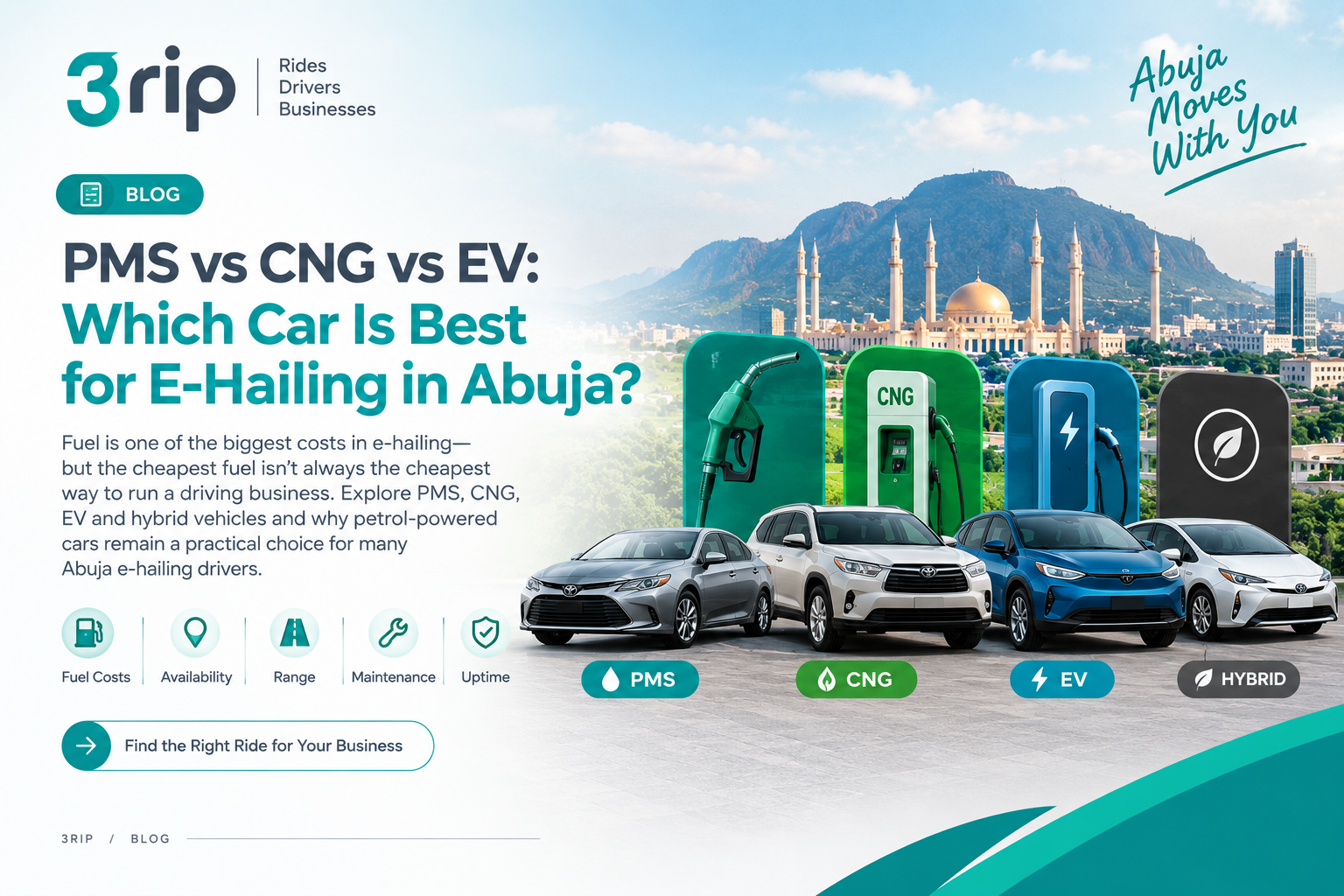
PMS, CNG or EV? Which Powertrain Makes the Most Sense for E-Hailing in Abuja?
Fuel is one of the biggest expenses facing every e-hailing driver. But the cheapest fuel on paper isn't always the cheapest way to run a business.
For an e-hailing driver, every minute matters.
A driver isn't simply buying fuel to move from one location to another. They are paying for the energy that keeps their business running—through traffic, between trips, during peak periods, on airport runs and across Abuja's growing network of roads.
That raises an important question:
Should an e-hailing driver choose petrol (PMS), CNG, an electric vehicle, or another powertrain?
The answer depends on the driver's vehicle, budget, operating area and access to infrastructure.
But for many drivers operating in Abuja today, petrol-powered vehicles remain one of the most practical choices for e-hailing.
Here's why.
The Real Cost of E-Hailing Isn't Just Fuel
When comparing vehicles, it is easy to look at the price per litre or the cost per kilometre and stop there.
That's not enough for a commercial driver.
An e-hailing vehicle has to consider:
- Fuel or energy cost
- Availability of refuelling or charging
- Time spent refuelling
- Vehicle purchase price
- Conversion cost
- Maintenance
- Range
- Passenger capacity
- Reliability
- Resale value
- Downtime
- Access to spare parts
- Ability to operate outside major corridors
A vehicle that saves money on energy but keeps a driver off the road for hours isn't necessarily the most profitable vehicle.
For an e-hailing driver, **uptime is money.
- 1PMS: The Workhorse of Nigerian E-Hailing
Premium Motor Spirit, commonly known as petrol, remains deeply integrated into Nigeria's transportation system.
That matters.
Petrol vehicles can be refuelled across a large network of conventional filling stations, making it relatively easy for a driver to continue working without planning the entire day around a particular energy station.
Recent NNPC pricing placed Abuja petrol at about ₦1,430 per liter, although pump prices vary by location and can change as market conditions change.
Yes, petrol is expensive.
But an e-hailing driver isn't choosing between "expensive petrol" and "free alternatives."
The real decision is:
Which vehicle gives me the best combination of operating cost, uptime, reliability and earning potential?**
And this is where PMS remains highly competitive.
Why PMS Can Still Make Sense for E-Hailing
- 1Refuelling is Convenient
One of the biggest advantages of petrol is simple:
You know where to find it.
Petrol stations are already part of Nigeria's transportation infrastructure.
If a driver needs fuel during a busy afternoon, they don't necessarily have to search for a specialised CNG station or an available charging point.
For an e-hailing driver, that convenience can translate directly into more time on the road.
And more productive hours can mean more completed trips.
- 2No Conversion Cost
A petrol vehicle doesn't require a CNG conversion before it can operate on petrol.
A driver can buy a compatible petrol vehicle, insure it, maintain it and start working.
CNG conversion, on the other hand, can require an upfront investment and access to qualified conversion services.
That doesn't mean CNG is a bad option.
It means the economics have to be calculated over the entire life of the vehicle**, not simply by looking at the price of CNG at the pump.
- 3Petrol Vehicles Offer Huge Vehicle Choice
One of the biggest advantages of PMS is the sheer number of vehicles already designed around it.
Drivers can choose from a wide range of:
- Compact sedans
- Saloon cars
- Hatchbacks
- SUVs
- Seven-seaters
- Comfort vehicles
- Used vehicles
- New vehicles
This is particularly important for an emerging e-hailing driver who may not have the capital to purchase a specialised vehicle.
The more vehicle choices available, the easier it is for drivers to find a car that fits their budget and their preferred e-hailing category.
- 4Range and Flexibility Matter
An e-hailing driver doesn't know exactly where the next profitable trip will come from.
A driver could start in Gwarinpa, receive a trip to the city centre, then get another request toward the airport.
That unpredictability makes range and refuelling flexibility important.
With a conventional petrol vehicle, the driver can generally refuel and continue operating without needing to locate a specific charging or CNG facility.
For drivers who operate long hours or move across different parts of Abuja, operational flexibility can be worth more than a lower headline energy price.
- 5Petrol Maintenance Is Familiar
Nigeria has a large ecosystem of mechanics, technicians, spare-parts dealers and service centres familiar with petrol-powered vehicles.
That creates another advantage for commercial drivers:
When something goes wrong, finding someone who understands the vehicle is usually easier.
For an e-hailing driver, this matters enormously.
A vehicle sitting in a workshop isn't earning.
The best commercial vehicle isn't necessarily the vehicle with the most advanced technology.
Sometimes, it is the vehicle that can be repaired quickly and returned to work.
But What About CNG?
CNG deserves serious consideration.
Nigeria is actively expanding its CNG ecosystem, and the Federal Government has been supporting conversion programmes and additional refuelling infrastructure. In March 2026, the Presidential Initiative was expanded to cover both CNG and electric vehicles, with a mandate to accelerate infrastructure and vehicle conversion.
By September 2026, government officials reported that more than 120,000 vehicles had been converted to CNG nationwide and that the number of CNG refuelling stations had expanded significantly.
CNG can therefore make strong economic sense for a high-mileage commercial driver.
In fact, official statements have highlighted substantial potential fuel savings from CNG-powered vehicles.
So why not simply switch every e-hailing vehicle to CNG?
Because fuel cost is only one part of the equation.
A driver must also consider:
Where can I refuel?
How long will I wait?
What is the conversion cost?
Is the vehicle properly converted and maintained?
What happens when I travel outside my normal CNG corridor?
How does the conversion affect my vehicle and its resale value?
The CNG network is growing, but it is still developing.
That means CNG can be an excellent option for the right driver in the right operating environment, rather than automatically being the best choice for every driver.
What About Electric Vehicles?
Electric vehicles are perhaps the most interesting long-term development in mobility.
They offer potential advantages including:
- Lower energy cost per kilometer
- Fewer conventional engine components
- Quiet operation
- Regenerative braking
- No tailpipe emissions
- Potentially lower routine maintenance
Nigeria is also beginning to expand EV charging infrastructure. For example, an NNPC Retail station commissioned in Abuja in September 2026 included an 86-point EV charging facility, demonstrating that charging infrastructure is beginning to become part of the country's mobility landscape.
But commercial e-hailing requires more than a charging point here and there.
It requires a network.
A driver needs to consider:
- Charging availability
- Charging speed
- Battery range
- Battery degradation
- Purchase price
- Replacement cost
- Electricity reliability
- Charging downtime
- Access to qualified EV technicians
- Spare parts availability
For a private commuter who drives predictable distances, these challenges can be manageable.
For an e-hailing driver working long hours, they require much more careful planning.
And What About Hybrid Vehicles?
Hybrid vehicles are an interesting middle ground.
They combine an internal-combustion engine with electric assistance.
For city driving, hybrids can potentially reduce fuel consumption while maintaining the flexibility of a conventional fuel system.
For e-hailing, this can be attractive because the vehicle doesn't depend entirely on charging infrastructure.
However, hybrids can have higher purchase costs and more specialized components than conventional petrol vehicles.
Again, the question isn't simply:
"Which technology is newest?"
The better question is:
"Which vehicle gives this driver the strongest business economics?"
The E-Hailing Vehicle Decision
Here's a simple way to look at the major options:
These are practical considerations, not universal rankings. Actual economics depend on vehicle model, fuel prices, driving pattern, maintenance and local infrastructure.
So, Is PMS Still the Best for E-Hailing?
For many Abuja e-hailing drivers today, yes.
Not because petrol is the cheapest energy source.
It isn't.
And not because CNG or EV technology lacks potential.
It doesn't.
PMS remains compelling because it combines several things commercial drivers need right now:
Availability
Fuel is widely accessible.
Flexibility
Drivers can travel without planning around specialised energy infrastructure.
Vehicle choice
There is a large selection of petrol-powered vehicles suitable for e-hailing.
Serviceability
Nigeria has an established ecosystem of mechanics and spare parts.
Familiarity
Drivers already understand how petrol vehicles operate and are maintained.
Uptime
A driver can refuel quickly and get back to work.
For a driver whose income depends on being available for trips, those advantages matter.
The Future Isn't About One Fuel
CNG is growing.
EVs are coming.
Hybrid technology is developing.
And petrol isn't going to disappear overnight.
The smartest e-hailing industry won't treat this as a battle between technologies.
Instead, it should recognise that **different vehicles will make sense for different drivers.
A driver with easy access to CNG, high daily mileage and a suitable vehicle may find CNG highly attractive.
A driver with reliable home or workplace charging and an appropriate EV may benefit from electric mobility.
A driver who needs maximum flexibility, broad refuelling access and a vehicle that can be serviced almost anywhere may find a petrol-powered car remains the most practical choice.
What This Means for 3rip Drivers
At 3rip, we believe drivers should have the freedom to choose a vehicle that works for their business.
The goal isn't to tell every driver:
"Buy this type of car."
The goal is to help drivers understand their economics and choose intelligently.
Because the most important number isn't the price of a litre of petrol.
It isn't the price of an SCM of CNG.
And it isn't the cost of a kilowatt-hour of electricity.
It's what you actually take home after completing your day's work.
That's the number that matters.
The Bottom Line
PMS-powered vehicles may not have the lowest fuel cost per kilometer.
CNG may offer significant fuel savings where infrastructure and access make it practical.
EVs may deliver compelling running economics where charging is convenient.
Hybrids can offer an attractive balance between fuel efficiency and flexibility.
But for many Nigerian e-hailing drivers—especially those who need maximum flexibility and dependable access to refuelling—PMS-powered vehicles remain one of the strongest practical choices today.
The best commercial vehicle is the one that keeps you:
On the road.
Taking trips.
Serving riders.
And earning.
Choose the vehicle that works for your business—not simply the fuel with the lowest price.
Ready to Drive With 3rip?
Whether your vehicle runs on PMS, CNG, hybrid technology or another approved powertrain, 3rip's goal is simple:
Give drivers the opportunity to spend more time earning and less time worrying about the platform.
Join 3rip and be part of the next generation of mobility in Abuja.
Drive with 3rip. Move Abuja forward.
Ready to Experience Better Rides?
Download the 3rip app today on iOS and Android. Fixed fares, zero rain surge.