
The Future of Ride-Hailing in Abuja: Who Should Pay the Real Cost of a Ride?
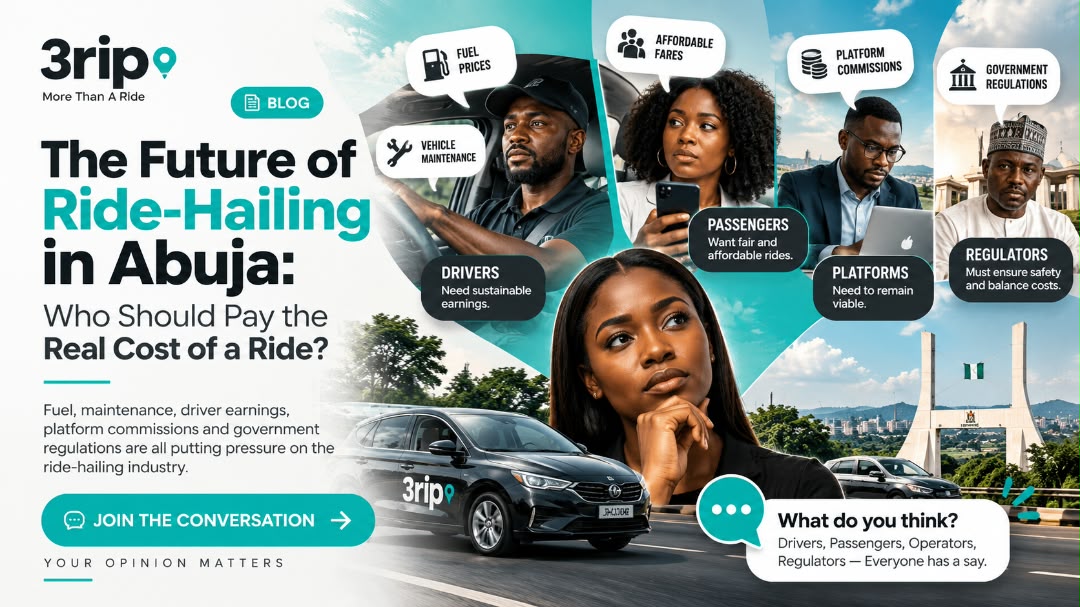
Fuel, maintenance, driver earnings, platform commissions and government regulations are putting increasing pressure on the ride-hailing ecosystem. Passengers want affordable fares. Drivers need sustainable income. Platforms need to remain viable, while regulators must balance public safety with the cost of doing business.
Who Should Pay More for the Ride?
The ride-hailing industry is facing a problem that nobody can ignore.
Fuel costs are rising, Vehicle maintenance is becoming more expensive.
Drivers are spending more to keep their cars on the road, Passengers are feeling the pressure of rising transport costs.
Ride-hailing platforms have technology, staff, safety, compliance and operational expenses to cover.
And governments are introducing regulations, licences, levies and other requirements that add another layer to the cost of doing business.
So we have a simple question:
Who should carry the rising cost of a ride?
Is it the passenger?
Should the driver accept a smaller margin?
Should ride-hailing platforms reduce their commissions?
Should government reconsider some of the costs imposed on the industry?
Or should everyone share the burden?
Maybe the answer is somewhere in between.
And this is where we want to hear from you.
🚗 Look at the Ride From the Driver's Seat
Imagine completing trips all day.
You pay for fuel.
You deal with traffic.
Your tyres wear out.
Your brakes wear out.
Your suspension needs attention.
Your engine needs servicing.
Your vehicle loses value every kilometer you drive.
Then a percentage of your fare goes to the platform.
At the end of the day, the amount collected from passengers is not the same as the amount that becomes the driver's actual income.
So the driver's question is understandable:
“After all my expenses, is this trip still worth it?”
🧑💼 Now Look at It From the Passenger's Seat
But passengers have their own reality.
The cost of food is rising.
Rent is rising.
School fees are rising.
Fuel is expensive.
Transportation is already taking a larger portion of many people's income.
So when a passenger sees a higher fare, the reaction may also be understandable:
“Can I afford to take this ride?”
A passenger shouldn't be made to feel guilty for wanting an affordable ride.
And a driver shouldn't be made to feel guilty for wanting to earn a reasonable living.
Both sides have a point.
🏢 What About the Platform?
There is another side that is sometimes forgotten.
A serious ride-hailing platform has to pay for:
- Technology and servers
- App development
- Customer support
- Driver support
- Marketing
- Payment processing
- Safety systems
- Verification
- Insurance-related requirements
- Staff
- Compliance
- Business operations
- Government regulatory requirements
A platform cannot survive if it gives away every trip at a loss.
But it also cannot survive for long if drivers and passengers believe the economics are unfair.
So platforms face their own difficult question:
How much is a fair commission?
🏛️ And Then There Is Government
Government has a legitimate role.
Passengers need protection.
Drivers need protection.
Road safety matters.
Businesses need regulation.
The industry needs standards.
But there is an important conversation to have:
At what point do regulations and levies become too expensive for the industry to absorb?
If the cost of operating legally becomes too high, the cost eventually moves somewhere else.
It may appear in the fare.
It may reduce the driver's earnings.
It may reduce the platform's investment.
Or it may push some operators toward informal or offline activity.
So regulation also needs balance.
⚖️ There Is No Easy Answer
This is why the conversation cannot simply be:
“Passengers should pay more.”
Or:
“Drivers should earn more.”
Or:
“Platforms should take less.”
Or:
“Government should charge less.”
The reality is more complicated.
Every part of the ecosystem is connected.
Change one part and something else is affected.
Increase fares too much and passengers may travel less.
Reduce fares too much and drivers may stop accepting trips.
Increase commissions too much and drivers may leave the platform.
Reduce commissions too much and the platform may struggle to operate.
Increase regulatory costs and somebody eventually carries the burden.
🤔 So What Is a Fair Ride?
This is the question we want to put to you.
What should determine the price of a ride?
Should it be based primarily on:
Distance?
Time spent in traffic?
Fuel prices?
Vehicle type?
Driver operating costs?
Demand?
Maintenance costs?
Government charges?
Platform operating costs?
Or should it be a combination of all of them?
💬 LET'S OPEN THE CONVERSATION
We don't want to tell you what the answer is.
We want you to help shape the conversation.
🧑✈️ Drivers:
What is your biggest challenge with the current fare structure?
🧑💼 Passengers:
What makes a fare feel fair to you?
🏢 Ride-hailing operators:
How should commissions be structured?
🏛️ Regulators:
What can be done to support a sustainable mobility industry while protecting the public?
👥 Everyone:
What would a fair ride-hailing system look like in Abuja?
🔥 THE BIG QUESTION
If the cost of running a vehicle keeps increasing...
If passengers cannot afford unlimited fare increases...
If drivers cannot continue working at unsustainable margins...
And platforms also have to survive...
What should change?
There may not be one perfect answer.
But there may be a better answer if drivers, passengers, platforms and regulators start talking to one another.
🗣️ YOUR TURN
Don't just read this article. Join the conversation.
Tell us what you think.
Drivers: What needs to change?
Passengers: What would make you feel you're getting value?
Industry operators: What is the fairest way to structure the economics?
Everyone: Who should carry the rising cost of mobility?
👇 Drop your thoughts in the comments.
Agree. Disagree. Challenge the argument.
Let's hear from you.
Because the future of mobility shouldn't be decided by one side alone.
3rip
More Than A Ride.
Let's move the conversation forward.
Ready to Experience Better Rides?
Download the 3rip app today on iOS and Android. Fixed fares, zero rain surge.